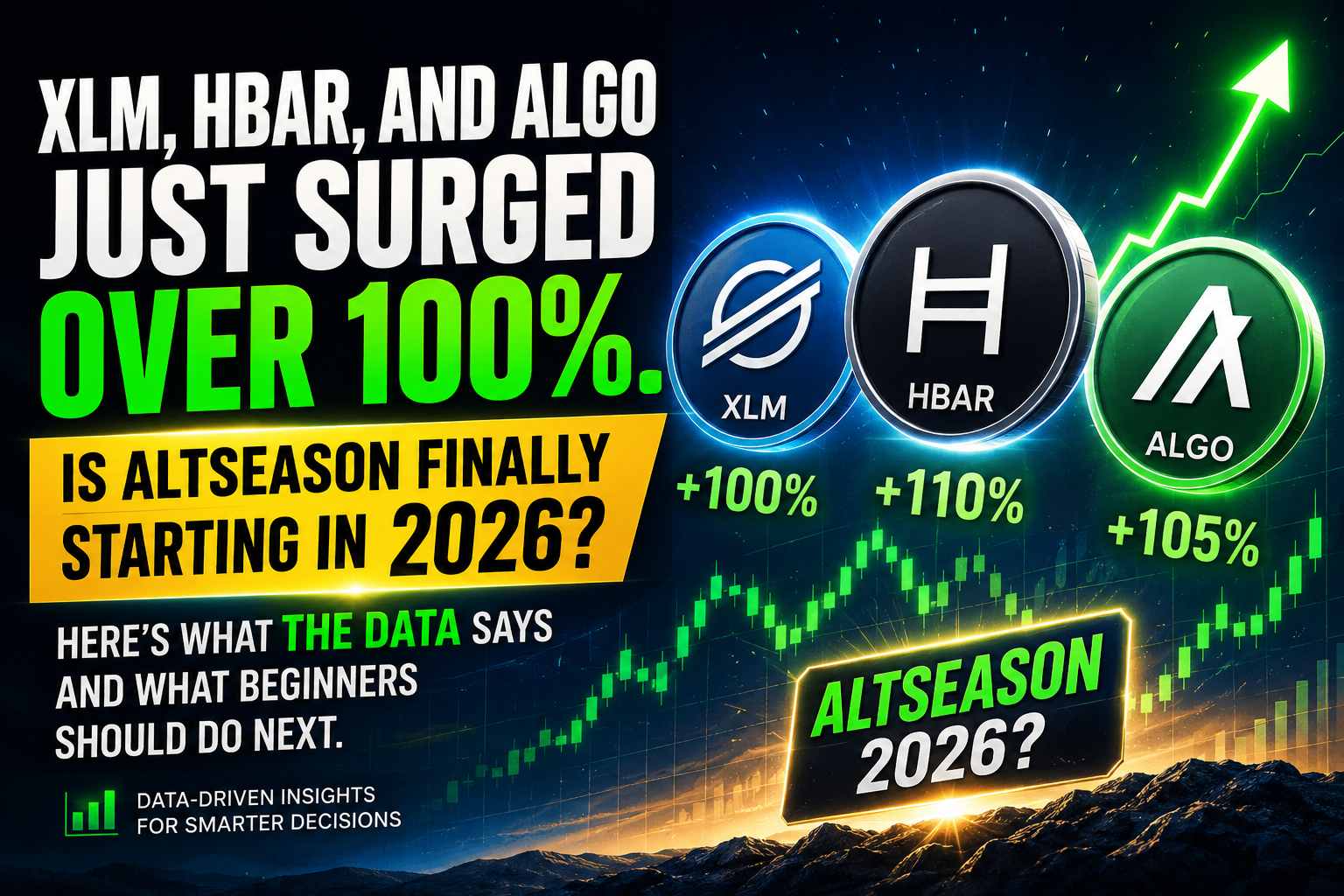
Something unusual is happening in the crypto market right now. Three altcoins — Stellar Lumens (XLM), Hedera (HBAR), and Algorand (ALGO) — have surged more than 100% within days while Bitcoin hovers near $74,000 after a 41% correction from its peak. Crypto communities on Reddit, X, and Telegram are buzzing with one question: has altcoin season finally begun?
If you're a beginner watching your portfolio or wondering whether to act, this article breaks it all down in plain English — no hype, no panic.
What Is Altseason, and Why Does It Matter?
Altseason (short for altcoin season) is a market cycle where alternative cryptocurrencies — everything except Bitcoin — outperform BTC significantly over a short period.
Here's how it typically works:
- Bitcoin dominates early in a bull cycle as new money enters the market
- Profits from BTC get rotated into altcoins in search of higher returns
- Smaller coins spike rapidly, often 100–500% in weeks
- The cycle eventually cools, and capital flows back to BTC or exits entirely
Historically, altseasons have produced some of the most explosive short-term gains in crypto — and some of the most brutal losses for people who entered too late.
What Just Happened With XLM, HBAR, and ALGO?
Stellar Lumens (XLM)
XLM jumped over 100% in a single week, with traders noting it "woke up" after months of stagnation. Stellar focuses on fast, low-cost international payments and has been quietly building institutional partnerships. Its move appears to be driven by renewed interest in real-world payment infrastructure crypto — especially as stablecoin and tokenization narratives grow in 2026.
Hedera (HBAR)
HBAR followed XLM closely, a pattern traders call "correlation pumping" — when one coin moves, related sentiment lifts nearby coins. Hedera's unique hashgraph technology and enterprise partnerships (including Google, IBM, and Boeing as governing council members) give it a fundamentals story that resonates when the market is risk-on.
Algorand (ALGO)
ALGO also saw a notable spike, continuing its pattern of participation in broader altcoin rallies. While Algorand's DeFi ecosystem is smaller than Ethereum's, its carbon-neutral blockchain and academic roots attract a loyal following that tends to buy momentum moves.
Is This the Real Altseason? What the Data Suggests
Whether this marks a true altseason or a short-term rotation depends on a few key indicators:
- Bitcoin Dominance — When BTC's market share falls below ~50%, capital is actively flowing into alts. Watch this metric on CoinMarketCap.
- Market Breadth — A real altseason lifts hundreds of coins, not just three. If only XLM, HBAR, and ALGO are moving, this may be a targeted rotation, not a broad season.
- Volume Confirmation — Price spikes without sustained volume often reverse quickly. Check 7-day volume trends before making any decision.
As of late May 2026, the signals are mixed. Some analysts believe the altcoin cycle is just beginning. Others caution that Bitcoin's own instability could drag altcoins down if BTC sees another leg down.
What Should Beginners Do Right Now?
- Do not FOMO into coins that have already doubled. The highest-risk moment to buy is after a 100% move.
- Research the project before the price. What does XLM actually do? Does HBAR's technology make sense to you? Price alone is never a reason to invest.
- Set a budget you can afford to lose entirely. Altcoins are high-volatility assets — 20–50% swings in a week are normal.
- Consider whether your time horizon matches the asset. Altseason trades often play out in days or weeks. Long-term investors in alts need patience for multi-year cycles.
The Bottom Line
XLM, HBAR, and ALGO's 100%+ moves are exciting and warrant attention. Whether this is the start of a broader altcoin season or a short-term spike remains to be seen. The smart approach is to stay informed, avoid impulsive decisions, and understand the assets you're considering before the market makes the decision for you.