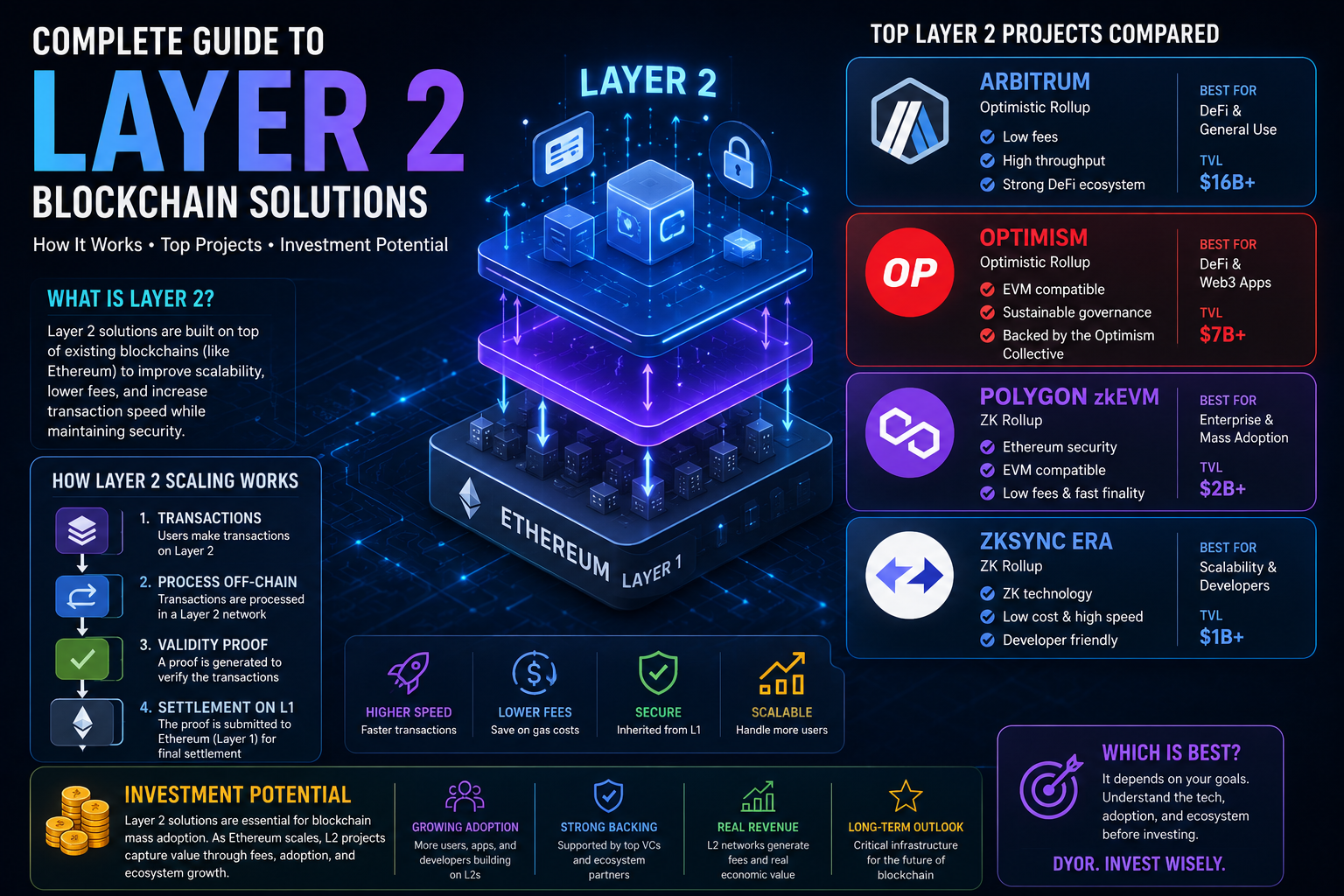
Complete Guide to Layer 2 Blockchain Solutions
Ethereum's explosive growth exposed a critical limitation: network congestion and high transaction fees. Layer 2 solutions emerged as the technological answer, processing transactions away from the main blockchain while still relying on Ethereum for settlement and security.
Today, Layer 2 protocols handle billions of dollars in value and have become a major part of blockchain infrastructure. This guide explains how Layer 2 solutions work, compares major platforms such as Arbitrum, Optimism, Polygon, zkSync, and StarkNet, and explores the investment potential behind this rapidly growing ecosystem.
Understanding Layer 2: The Problem It Solves
Bitcoin processes only a limited number of transactions per second, while Ethereum also has limited base-layer throughput. As blockchain adoption increased, this limitation became more visible. During periods of high demand, Ethereum users often faced expensive gas fees and slower transaction confirmation times.
Layer 1 scaling solutions try to improve the base blockchain itself, but they often involve tradeoffs. Increasing block size or changing consensus rules can affect decentralization and security. Layer 2 solutions take a different approach by moving most transaction activity away from the main chain while still using Layer 1 for final settlement.
How Layer 2 Technology Works
The Basic Concept
Layer 2 systems process many transactions outside the main blockchain, then submit a compressed summary back to Layer 1. This reduces congestion, lowers fees, and improves transaction speed.
A simple way to understand it is to imagine sending one envelope that contains hundreds of receipts instead of sending every receipt separately. Layer 2 networks bundle activity together, making the overall process more efficient.
Optimistic Rollups
Optimistic rollups assume transactions are valid by default. If someone believes a transaction is invalid, they can challenge it during a specific dispute period. This is why some optimistic rollups have longer withdrawal times back to Ethereum.
Arbitrum and Optimism are two of the most well-known optimistic rollup ecosystems.
ZK Rollups
ZK rollups use zero-knowledge proofs to mathematically prove that transactions are valid before submitting them to Layer 1. This approach can offer faster finality and stronger verification, but the technology is more complex to build and maintain.
zkSync and StarkNet are examples of Layer 2 networks built around zero-knowledge proof technology.
Sidechains
Sidechains are separate blockchains that run alongside Ethereum. They usually offer faster transactions and lower fees, but they do not always inherit Ethereum's full security model in the same way rollups do.
Polygon is often discussed in this category because it has historically operated with a separate validator system while also expanding into more advanced scaling solutions.
Major Layer 2 Platforms Compared
Arbitrum
Overview
Arbitrum is one of the largest Layer 2 ecosystems by total value locked and user activity. Built on optimistic rollup technology, it is compatible with Ethereum smart contracts, making it easier for existing Ethereum applications to deploy on the network.
Major DeFi protocols such as Uniswap, Aave, Curve, and many others have expanded into Arbitrum, helping the ecosystem grow quickly.
Strengths
Arbitrum has a strong developer ecosystem, deep liquidity, mature infrastructure, and strong network effects. Its early lead gives it an advantage because more applications attract more users, and more users attract more developers.
Weaknesses
Like other optimistic rollups, Arbitrum can involve longer withdrawal times when moving funds back to Ethereum. It also faces questions around sequencer centralization, which is an important topic across many Layer 2 networks.
Investment Potential
The ARB token is mainly used for governance. Its long-term investment potential depends on whether Arbitrum can continue growing transaction volume, attracting developers, and maintaining its position as a leading Ethereum scaling ecosystem.
Optimism
Overview
Optimism is another major optimistic rollup that plays an important role in the Ethereum Layer 2 landscape. It supports Ethereum-compatible applications and has built a strong community around open development and public goods funding.
Optimism is also known for the OP Stack, a framework that allows other projects to build their own Layer 2 networks using Optimism's technology.
Strengths
Optimism has a strong governance community, developer-friendly infrastructure, and a growing ecosystem of DeFi and Web3 applications. Its broader Superchain vision could make it more than a single Layer 2 network.
Weaknesses
Optimism competes directly with Arbitrum and other Layer 2 networks. Its challenge is to keep growing user activity and liquidity while proving that its ecosystem strategy can create long-term value.
Investment Potential
The OP token gives holders governance exposure to the Optimism ecosystem. Its investment potential depends on ecosystem adoption, Superchain growth, transaction demand, and the value captured by the network over time.
Polygon
Overview
Polygon became popular by offering fast and low-cost blockchain transactions. It has been widely used for DeFi, gaming, NFTs, and enterprise blockchain experiments.
Unlike pure rollups, Polygon historically operated more like a sidechain, although the project has expanded into newer scaling technologies including zk-based solutions.
Strengths
Polygon offers low fees, fast transactions, strong brand recognition, and broad enterprise adoption. Partnerships with major companies have helped Polygon stand out beyond the DeFi sector.
Weaknesses
Polygon's security model has often been viewed differently from rollups that inherit Ethereum security more directly. The ecosystem can also feel fragmented because Polygon has multiple scaling products and technical directions.
Investment Potential
Polygon's investment potential comes from adoption across gaming, NFTs, enterprise use cases, and scaling infrastructure. Its long-term success depends on whether it can remain relevant as rollups and zk-powered solutions become more competitive.
zkSync
Overview
zkSync is a Layer 2 network based on zero-knowledge rollup technology. Its goal is to offer faster, cheaper, and more secure transactions while preserving compatibility with Ethereum-based applications.
ZK technology is often seen as one of the most important directions for blockchain scaling because it provides mathematical proof of transaction validity.
Strengths
zkSync benefits from strong technical positioning, fast finality potential, and growing interest in zero-knowledge infrastructure. It is part of a broader movement toward more advanced cryptographic scaling systems.
Weaknesses
The zkSync ecosystem is still smaller than Arbitrum and Optimism. ZK rollup technology is also more complex, which can slow development and make adoption more difficult for some builders.
Investment Potential
The investment potential of zkSync depends on whether zero-knowledge rollups become the dominant scaling model. If users and developers increasingly prefer zk-based systems, zkSync could benefit from early positioning in this category.
StarkNet
Overview
StarkNet is another zero-knowledge rollup ecosystem, but it uses a unique technology stack and programming model. It is designed to support advanced computation while proving transaction validity off-chain.
This makes StarkNet one of the more technically ambitious Layer 2 projects in the crypto market.
Strengths
StarkNet offers strong cryptographic foundations, flexible computation, and a unique development environment. Its technology could support applications that are difficult or expensive to run directly on Ethereum.
Weaknesses
StarkNet has a smaller user base and ecosystem compared to leading Layer 2 networks. Developers also need to learn its specific programming model, which can create a barrier to adoption.
Investment Potential
StarkNet may offer higher-risk, higher-reward exposure to zero-knowledge scaling. Its future depends heavily on developer adoption, ecosystem growth, and whether its technical advantages translate into real user demand.
Layer 2 Comparison
Security
Arbitrum and Optimism rely on optimistic rollup security models and settle back to Ethereum. zkSync and StarkNet use zero-knowledge proofs to verify transaction validity. Polygon offers fast and low-cost transactions, but its security model has historically differed from Ethereum rollups.
Transaction Fees
Polygon is often known for very low fees. Arbitrum and Optimism are usually cheaper than Ethereum mainnet but may vary depending on network activity. ZK rollups can also offer low fees, especially as the technology improves and Ethereum upgrades reduce Layer 2 data costs.
Withdrawal Experience
Optimistic rollups can involve longer withdrawal periods because of the challenge window. ZK rollups can offer faster finality because transactions are mathematically proven valid before settlement.
Ecosystem Growth
Arbitrum currently has one of the strongest DeFi ecosystems. Optimism is building a broader network strategy through the OP Stack. Polygon has broad adoption across DeFi, NFTs, gaming, and enterprise use cases. zkSync and StarkNet are still growing but represent important next-generation scaling approaches.
Investment Considerations for Layer 2 Tokens
Tokenomics
Layer 2 tokens may derive value from governance rights, ecosystem incentives, staking models, or future fee capture mechanisms. Investors should understand how each token is actually used before assuming that network growth automatically benefits token price.
Ecosystem Maturity
A strong Layer 2 ecosystem usually includes decentralized exchanges, lending platforms, bridges, developer tools, stablecoin liquidity, and active users. Networks with diverse applications are generally more resilient than those dependent on only one or two major protocols.
User Experience
Layer 2 adoption depends heavily on user experience. Faster bridges, cheaper fees, simpler wallets, and smoother app interfaces can help bring more users into the ecosystem.
Real Network Demand
Investors should look beyond hype and check whether a Layer 2 network has real usage. Daily active users, transaction volume, developer activity, and fee generation are more useful signals than marketing claims alone.
The Ethereum Dencun Upgrade and Layer 2 Costs
Ethereum's Dencun upgrade introduced improvements designed to reduce Layer 2 transaction costs. Lower costs can make Layer 2 networks more attractive for users, developers, and applications that need cheaper transactions.
This upgrade changed Layer 2 economics by making scaling infrastructure more efficient. While lower fees can reduce margins, they can also encourage higher transaction volume and broader adoption.
The Future of Blockchain Scalability
Layer 2 solutions are likely to remain essential for blockchain scalability. Instead of one single winner, the market may support multiple Layer 2 networks serving different use cases.
Some users may prefer Arbitrum for DeFi liquidity, Optimism for the Superchain ecosystem, Polygon for enterprise and consumer applications, zkSync for zk-powered scaling, and StarkNet for advanced computation.
Balanced Conclusion
Layer 2 solutions represent one of the most important infrastructure categories in crypto. They help blockchains scale by reducing fees, increasing throughput, and improving user experience without completely abandoning Layer 1 security.
Arbitrum, Optimism, Polygon, zkSync, and StarkNet each offer different tradeoffs. Arbitrum and Optimism have strong optimistic rollup ecosystems. Polygon has broad adoption and low-cost infrastructure. zkSync and StarkNet represent the future potential of zero-knowledge scaling.
For investors, Layer 2 tokens can offer exposure to blockchain adoption and Ethereum scaling. However, token value depends on more than technology. Ecosystem growth, real usage, governance value, tokenomics, and long-term demand all matter.
The safest approach is to study each project carefully, understand the risks, and avoid making decisions based only on hype or short-term market narratives.